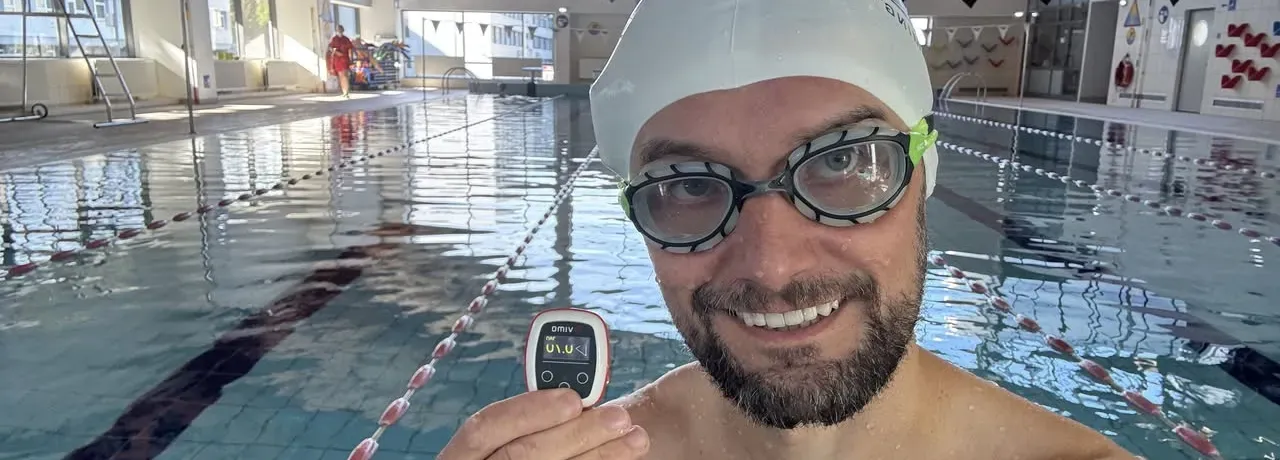
I had a swim today, and afterwards I sat down and made charts. Partly because I can, and partly to prove to myself that I am getting better. The data does not lie, as long as it is correct.
The session was 1 km in a 25 m pool, so 40 lengths. I started with a calm metronome on the Vimo Swim: 1.45 s between beeps. After every 25 m I made it faster, step by step, down to 0.75 s. Then I eased off, swam a block at a steady pace, and went fast again at the end. I like a strong finish. As hard as I can.
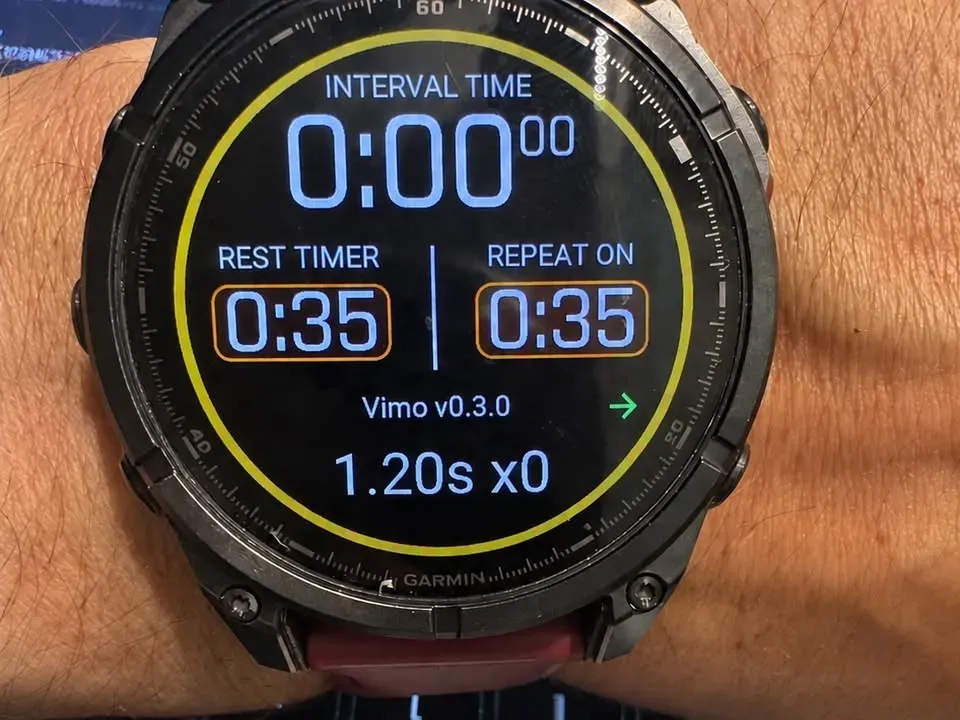
There is also news from the Garmin side. Vimo Swim has had an official Garmin integration for a few days now. Our watch app, Vimo Tempo, which saves the metronome tempo into the Garmin activity, is waiting for verification.
The ladder in numbers
The first thing the charts showed: listening to the metronome really works. At 1.45 s one length took me 26 s. At 0.75 s it took 19 s.
| Metronome | Time per 25 m | Pace per 100 m | Lengths |
|---|---|---|---|
| 1.45 s | 26.0 s | 1:44 | 1 |
| 1.0 s | 22.7 s | 1:31 | 10 |
| 0.75 s | 19.0 s | 1:17 | 1 |
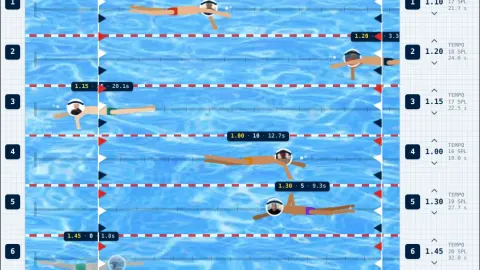
Same swimmer, three tempos
Three real lengths from this session, in real time.
Put another way: when the fastest version of me touches the wall after 19 s, the 1.45 s version is only at about 18 m.
Same tempo, different lengths
The second finding is more interesting. At the same metronome setting, some of my lengths were up to 6 s per 100 m apart. The beep was the same, so the stroke rate was the same. The gap came from technique: a better push-off, a longer glide, calmer breathing.
Compare lengths swum at the same tempo, not just fast against slow. That is where you see technique, because the metronome takes stroke rate out of the equation.
My threshold is 0.9 s
The third finding gives me a target for the next session. I drew a line at 1:30 per 100 m and counted the lengths on each side.
18 of 18
under 1:30 at 0.90 s and faster
3 of 22
under 1:30 with a slower metronome
Each dot is one 25 m length. So at 0.9 s and faster, every single length was under 1:30. With a slower metronome I managed it only 3 times out of 22. The goal now is to hold that speed at a lower stroke rate. Less work, same result.
Why intervals fit a metronome
Interval training means short, hard efforts with planned rest between them. A few reasons I like it:
- You swim faster than you could non-stop. The rest lets you hit a high pace again and again.
- More speed and fitness in less time. Work above your comfort level raises VO2max faster.
- Easy to measure. Every repeat is a small test, and you can compare lengths swum at the same tempo.
- Made for a metronome. With Vimo Swim you can change the tempo for every repeat, like this ladder, and see right away which tempo you can hold.
- Less boring. A set of 20 x 25 m with a clear goal feels shorter than 40 lengths in one go.
Still, intervals will not replace long, even swims for me. Those build the endurance base.
flowchart LR
    A["Vimo Swim<br/>metronome"] --> B["Stroke rate<br/>(the base)"]
    C["Technique<br/>push-off, glide, breath"] --> D["Time per length"]
    B --> D
What it took
One kilometre, a metronome I could change every length, and a Garmin watch logging each length. The charts took longer than the swim. Next time I will set the ladder around 0.9 to 1.0 s and work on the lengths that miss 1:30, instead of only chasing faster beeps. We will see what the next session brings.

Related notes
Verified Human Cert MCP Server: Prove Your Music Is Human-Made, Right from the Terminal
I built an MCP server that queries the Verified Human Cert registry. Verify human-made music certifications by ISRC, artist, track, or cert number directly from Claude Code.
Mirroring a Wearable OLED Display to a Projector for Live Demos
How to stream a tiny OLED screen from an embedded device to a laptop and projector in real-time using UART and Python. A practical guide for hardware demos and presentations.