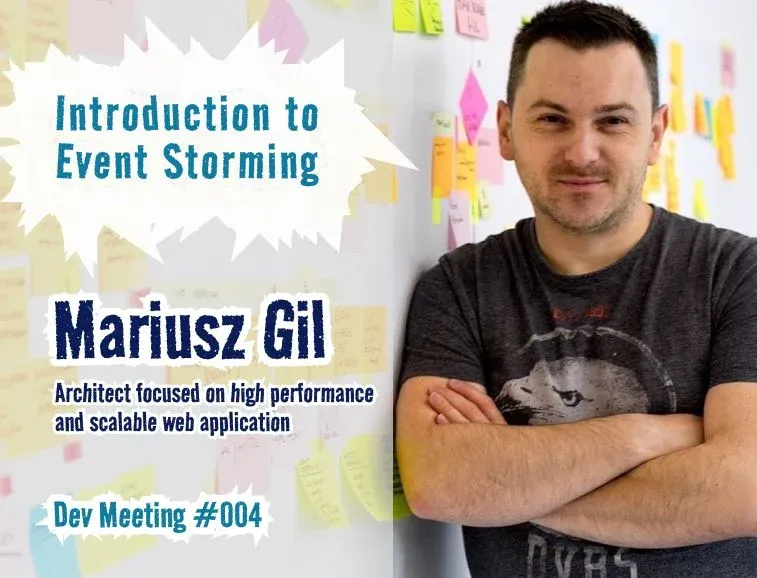
Dev Meeting 004: Introduction to Event Storming
My notes on Event Storming, a workshop-style method for exploring complex systems and business domains by mapping the flow of events and interactions.
Key takeaways
- Event Storming maps business events with sticky notes to build shared understanding.
- Include business, development, and operations perspectives to surface hidden issues.
- Best for new projects, legacy refactoring, or aligning teams on actual processes.
- Requires a skilled facilitator and a collaborative team culture to be effective.
Event Storming is a workshop-based method for exploring complex systems and business domains. Using sticky notes (or digital equivalents), participants map out events, actions, and actors to build a shared understanding of how a system works. The method was created by Alberto Brandolini and is widely used in Domain-Driven Design (DDD) contexts.
For this dev meeting of my team at the time, I invited Mariusz Gil — architect, ex-CTO, trainer, and conference speaker focused on high-performance and scalable web applications.
Key Rules
Have a clear understanding of the problem you're solving before the workshop begins. This keeps the team focused.
The visual nature of Event Storming is essential. Sticky notes (or digital tools like Miro) represent events, commands, and actors.
Include people from business, development, and operations. Different viewpoints surface issues that would otherwise be missed.
This isn't about detailed technical diagrams. It's a high-level view of how events flow through the system.
Pros and Cons
- Creates a shared understanding across teams - Identifies bottlenecks and improvement opportunities - Encourages collaboration and communication - Works across different domains (business processes, software, org structures) - Can be done remotely with digital tools - The output serves as living documentation
- Time-consuming for complex systems - Requires a skilled facilitator - Best suited for event-driven systems — less effective for simple interactions - Captures a single point in time — may miss evolving aspects of the system - Needs a collaborative team culture to be effective
When to Use It
Event Storming works best when you're starting a new project and need to understand a complex domain, when you're refactoring a legacy system and want to map existing behaviour, or when business and development teams need to align on how a process actually works (not how documentation says it works).
For a deeper dive, check out Alberto Brandolini's book Introducing EventStorming and Mariusz Gil's talks and workshops.
Dev Meeting 003: Web3 Primer
My notes from a Web3 primer. Learn how network interactions are evolving and why companies are adopting Web3 elements in their projects.
Dev Meeting 001: Kubernetes is a Framework
My notes on Kubernetes as a framework: from Google's scaling challenges and Borg to Operators, CRDs, and modern container orchestration basics.